Download your copy of SEO Trends 2025 and discover what to be hopeful about in a changing search world.
Maximize your SEO efforts in 2024 with insights on Google’s SGE, algorithm updates, and expert tips to keep your site ahead.
Download this guide and learn how to optimize and manage Google Performance Max campaigns, with expert insights and actionable strategies to ensure your campaigns are effective.
Join us in analyzing 3 case studies that show the importance of driving brand search behavior and engagement, and how to do it in months, instead of years.
Join us in analyzing 3 case studies that show the importance of driving brand search behavior and engagement, and how to do it in months, instead of years.
Join us as we dive into exclusive survey data from industry-leading SEOs, digital marketers, content marketers, and more to highlight the top priorities and challenges that will shape the future of search in 2025.
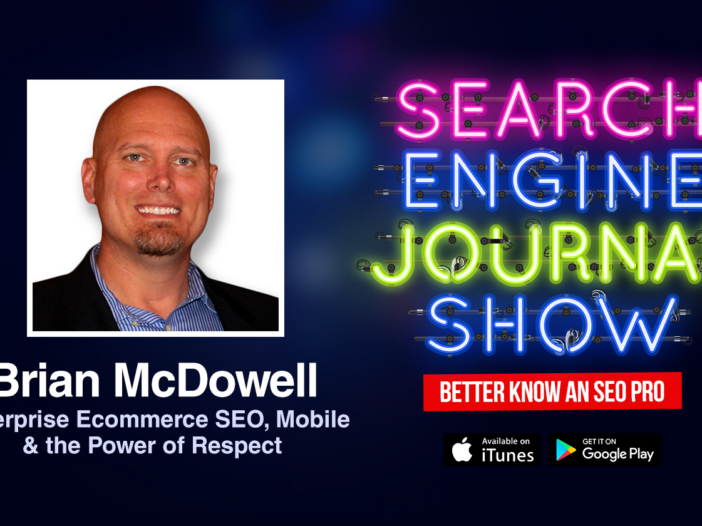
Brian McDowell of BloomReach shares his insights on enterprise ecommerce SEO, mobile search, the power of respect, and more.
Podcast: Download
Subscribe: Apple Podcast Google Podcasts Spotify
“It was a combination of really smart people and a leadership mentality that I looked up to, that allowed me to grow, learn and focus on something that I enjoyed… I’m 45 years old, and to have a mentor in my career, that keeps me engaged and opens up a different lens to look at the industry, it’s hard to find when you try to continue to grow in an industry like this.”
Over the years, Brian McDowell has shared a wealth of knowledge to the industry with his data-driven insights and presentations. In the process, he has earned the respect of the community with his kindness and helpfulness.
This enterprise SEO and digital marketing veteran has worked with some of the world’s largest brands, yet he remains open in “helping somebody else get to where they want to be.”
When asked what he wanted to be known for in the SEM space, Brian replied:
“Respect – for people and the process. Everything we do for our company, clients, the industry and our families amount to nothing if not handled with a level of respect for others and their abilities. Many say respect is earned but I disagree. Respect is given from the first handshake but can be easily lost. When you lose someone’s respect it is impossible to ever get it back. This is an important trait when you are dealing with multiple teams that require different approaches. Those who have my deepest respect undoubtedly know it.”
At a time when this basic but important concept is often overlooked, Brian reminds us of the power of respecting others and what we do. And this is why we definitely need to get to know him better.
Brian McDowell is the Principal Digital Strategist at BloomReach. Previously, he was the Director of Search Intelligence and Co-founder at Conductor, as well as the former Lead SEO for Red Ventures and LendingTree.
For the past 13 years, Brian has been focused solely on SEO – providing enterprise-level SEO solutions with a heavy focus on ecommerce. But he actually started his career as a software engineer and web designer in the late ’90s.
You can read some of Brian’s work on the Conductor website, but you’re more likely to catch him speaking at a conference.
Since 2010, he’s been educating, sharing insights and reviewing case studies by speaking at events like Pubcon, eTail East, Commerce Next, Internet Summit, Search Exchange, C3, StartUp Institute, Inbound Marketing Summit, SMX, Market America International Convention and SEMCLT.
In today’s edition of Better Know an SEO Pro, I will be talking to Brian McDowell who shares his insights on enterprise ecommerce SEO, mobile search, and the power of respect.
How to connect with Brian McDowell:
Twitter | LinkedIn
Visit our podcast archive to listen to other Search Engine Journal Show podcasts!
Image Credits
Featured Image: Paulo Bobita
Danny Goodwin is the former Executive Editor of Search Engine Journal. He formerly was managing editor of Momentology and editor …
Conquer your day with daily search marketing news.
In a world ruled by algorithms, SEJ brings timely, relevant information for SEOs, marketers, and entrepreneurs to optimize and grow their businesses — and careers.
Copyright © 2024 Search Engine Journal. All rights reserved. Published by Alpha Brand Media.
13 Podcast SEO Tips to Know Before Hitting Record – Rev.com

Forget meeting fatigue, missed details, and tedious tasks. VoiceHub will change the way you work. Coming soon.
Forget meeting fatigue, missed details, and tedious tasks. VoiceHub will change the way you work. Coming soon.
Forget meeting fatigue, missed details, and tedious tasks. VoiceHub will change the way you work. Coming soon.
Forget meeting fatigue, missed details, and tedious tasks. VoiceHub will change the way you work. Coming soon.
Team of one. Global operation. Everything in between. We’ve got it all covered. Rev handles the tedious job of transcripts, captions, and subtitles so you’ll get work done faster. If you haven’t found what you need yet, we still bet we can help.
Team of one. Global operation. Everything in between. We’ve got it all covered. Rev handles the tedious job of transcripts, captions, and subtitles so you’ll get work done faster. If you haven’t found what you need yet, we still bet we can help.
How can a podcast increase SEO? There are many ways, from boosted audiences to increased authority. Let’s look at some podcast SEO best practices for your brand.
Luckily for you, we deliver. Subscribe to our blog today.
A confirmation email is on it’s way to your inbox.
A podcast can increase SEO by expanding your audience to a new type of content format, providing extra opportunities to bring keywords into your content strategy, and giving your users more opportunities to enjoy your content on the go. All of these things will increase your authority on your chosen subject matter and increase your SEO as a result.
Optimizing your podcasts by utilizing metadata, using appropriate podcast keywords, and staying consistent with your brand will help Google index your content and will help you rank.
Let’s look at some podcast SEO tips to learn more about how you can optimize your podcasts and increase your overall presence online.
Creating a podcast is a great way for content creators, brands, businesses, and more to develop a loyal audience and create content in an interesting and digestible way. Let’s look at how SEO for podcasts can help optimize your episodes and get more eyes (and ears) on your work.
Creating a website for your podcast not only gives you a dedicated hub to house your episodes, it also can help with your rankings. On your website, you can provide optimized episode descriptions, blog posts with episode transcripts, and more, creating authority for your podcast and giving people a place they can go to learn more.
Get started: Look for a website hosting service that can help you choose a template and get your website up and running easily.
Having transcriptions of your podcast episodes available helps Deaf or hard-of-hearing people be able to access your content, while also helping boost SEO by providing written summaries of your dialog. These written summaries give even more context to search engines about your podcast content so they can rank it accordingly.
Get started: Transcribing podcast episodes doesn’t have to be difficult; services like Rev can do so quickly and easily! Look into Rev’s VoiceHub feature to see how you can transcribe your podcast.
Tagging is hugely important for any SEO strategy. It lets users know exactly what your content is about and directs searches to your episode, blog, or photo. Tagging your podcast episodes with relevant keywords will help inform search engines about your episode content and boost your podcast.
Get started: When uploading your podcast episode, there should be a space to input content tags. Put in SEO keywords that are relevant to your episode, and make sure to use the same category tags per episode type so listeners can easily find more of your work.
While you might not know the title of an episode of television, the titles of podcast episodes are extremely important. They help users scrolling through your episode catalog know what to expect in each installment so they can choose what to listen to. Optimizing these titles with SEO keywords can help accomplish the goal of helping your users choose the right episode while also giving search engines the ability to catalog your content.
Get started: Take the keyword most relevant to your episode and expand on it to create a natural-sounding podcast title.
Any written part of your podcast (no matter how small) is a great time to introduce keywords. With something as important as your podcast’s title, including the most relevant (and highest ranking) keyword can help boost your podcast by drawing people looking for that keyword to your episodes.
Get started: Decide what you want to focus on and conduct keyword research to pick the best keyword for your content. From there, integrate it into your title in a way that feels natural and not forced.
The metadata of your podcast includes things like: title, subtitle, authors, description, genre, podcast keywords, and tags. All of these features are great ways to insert relevant keywords and drive home your content strategy. Optimize all of these during the upload process where it feels appropriate.
Get started: When uploading your podcast, insert relevant keywords into every metadata field that works. All of these fields should be present while you are uploading your podcast to your hosting platform.
Creating a well-researched and thorough podcast episode won’t do you much good if it isn’t actually what your audience is looking for. Conducting keyword research using SEO tools can help identify what your target audience is actually looking for so that you’ll get good engagement every time.
Get started: Log into an SEO tool like Semrush or ahrefs and look up a list of topics that are relevant to your audience or niche. See which ones have the most engagement and search volume, and make a list of which ones could work for your content, then input them into the Spotify keyword feature during podcast upload.
If you want eyes on your content, posting on YouTube is a great place to start. Many podcasts have a video component that pairs with the episode (whether it’s a video of the podcast hosts recording the episode or just a video of the audio). Since YouTube is a leading platform, establishing authority on it can help boost your rankings in general.
Get started: Film a video while you record your podcast, or overlay your audio with a photo of your logo and upload that to YouTube.
Some podcast episodes can get quite long, so users who are looking for a specific section might have to play the “fast forward, rewind, rinse, repeat” game until they find it. Eliminating this back and forth can make your podcast easier for your audience to listen to, and is also a great opportunity to insert your target keywords. Each timestamp — where applicable — can include one of these relevant keywords.
Get started: When uploading your podcast to your chosen hosting software, you will be able to add in timestamps. While recording and editing, write down moments where the subject changes or key topics are brought up and write it down so you can remember where to put one.
A good SEO strategy is all about nailing down what points you make, what topics you cover, and what keywords you mention so that search engines can index it accordingly. Creating a blog post that expands on or summarizes your podcast content (hint: a transcription is a great way to do this) can help nail down your message and is a great way to repurpose your podcast.
Get started: Using a transcription or just listening back to your podcast episode, write an outline for a short accompanying blog post and publish it on your website.
Backlinks are the, well, backbone of an SEO strategy. They can help your content rank on search engine results pages and get more eyes on your content. You build backlinks by getting authoritative websites to post a link to your content on their website, which will drive users to your content.
Get started: Once you’ve recorded your episode or filmed your video, reach out to the biggest thought leaders in your industry and see if they’d be willing to listen and potentially share on their sites.
While some podcasts jump from topic to topic and succeed, most follow at least some sort of umbrella topic. Having a specific content niche or strategy can help you build a good reputation within your industry and become a trusted resource. So, being consistent with your messaging, podcast style, and keywords can help you build your brand over time and rank better.
Get started: As you brainstorm what you want to do for your podcast, make a comprehensive content strategy that you will follow as you continue to make episodes.
Cross-promoting your podcast on social media platforms (like posting snippets to TikTok or Reels, posting a video on Youtube, etc.) is a great way to expand its reach. And making sure that these other platforms are optimized can expand it even further. Instead of just simply posting to different platforms, optimize each platform by making sure your tags, keywords, and meta descriptions are all published as well.
Get started: Though it might be more work, don’t just set your podcast to automatically upload to other platforms. Manually go through each one and add your keywords, tags, etc.
When you devote your life and work to creating your podcast, blog, or brand, you want to get as many eyes on it as possible. This is where SEO for podcasts comes in. Optimizing your episodes will help you accomplish your content goals and grow your audience.
Why SEO matters:
Images don’t have a direct impact on boosting your SEO, but that doesn’t mean they aren’t necessary and don’t help move the needle at all. Google likes images, so having one is a bonus. And you can use image alt text to introduce some keywords, where applicable, and create even more authority.
Yes, video podcasts do help with SEO by continuing to build your brand, expanding your reach across various content platforms, and providing more backlink opportunities. While podcasts themselves may only be able to exist on podcast hosting platforms and social media, videos can also rank on Google’s video search and Youtube, which can increase their reach significantly. Adding a video to your podcast (especially if it comes with a video transcription) is a great way to get a quick SEO win.
Podcasts are a great way to draw users into your content. And with services like our VoiceHub, it’s easier than ever to get your podcast out there. The VoiceHub AI takes some of the hard work out of podcasting — it can create a seamless transcript, highlight important moments, and more, making audio SEO a breeze.
See how Rev VoiceHub can assist your podcast.
Lorem ipsum dolor sit amet, consectetur adipiscing elit, sed do eiusmod tempor incididunt ut labore et dolore magna aliqua. Ut enim ad minim veniam, quis nostrud exercitation ullamco laboris nisi ut aliquip ex ea commodo consequat. Duis aute irure dolor in reprehenderit in voluptate velit esse cillum dolore eu fugiat nulla pariatur.
Ordered list
Unordered list
Text link
Bold text
Emphasis
Superscript
Subscript
Lectus donec nisi placerat suscipit tellus pellentesque turpis amet.
Sign up to get Rev content delivered straight to your inbox.
'Mona Lisa And The Blood Moon' Trailer: Kate Hudson & Jun Jong Seo Star In Ana Lily Amirpour's Crazy New Trip – The Playlist

How an integrated PPC & SEO strategy got more mileage out of Swarovski’s media budget – The Drum

Advertisement
November 13, 2024 | 10 min read
Listen to article 4 min
Winning Gold award in The Drum Awards for Media in the SEO and PPC Integrated category is Jellyfish for Swarovski. Here is the award-winning case study.
Jellyfish helped Swarovski integrate a unified PPC and SEO strategy / Marjan Sadeghi
Search marketing today is complex. Soaring media costs, rapidly evolving consumer behavior and fragmented data mean that brands are continually looking for new ways to maximize their potential and stay ahead of the curve.
Pay-per-click (PPC) and search engine optimization (SEO) teams are typically divided, reporting to different departments with separate key performance indicators, targets, tactics and measurement tools – ultimately stifling any meaningful traction through the search marketing.
Impacted by economic uncertainty, low consumer confidence, poor spending ability and rising costs, leading jewelry and accessories brand Swarovski partnered with global digital marketing company Jellyfish to unleash the power of search. Together, they embarked on a journey with the shared vision that PPC and SEO are stronger together.
The partnership aimed at elevating the brand while also achieving a 5% year-over-year (YoY) increase in search revenue.
Jellyfish and Swarovski aligned the brand’s search channels through an overarching One Search strategy, bringing together paid and organic search to improve performance. This approach enabled Swarovski to own more of the search experience and be more relevant across the journey.
They connected PPC and SEO in order to: answer more search queries, from awareness through to conversion; engage more users with result formats that best met their specific intent; and convert more users by driving them through to performance-geared landing environments.
The One Search strategy framework was built around a combination of three core pillars: technology; talent; and process. This enabled the teams to move away from siloed search delivery to a more connected and integrated One Search model.
On the technology side, Jellyfish’s proprietary J+Search tool extracted data from Google Search Ads, Analytics, Search Console and Google Trends, to inform and measure collective search activities, and counteract the loss of data visibility, consent and privacy restrictions.
J+Search enabled search data to be organized in two specific ways: coupling paid and organic information and reconciling search term data at a keyword, landing-page, campaign or category level – highlighting opportunities for incremental growth, efficiency or testing across search.
Advertisement
Monitoring, with greater granularity, the correlation between PPC and SEO, gave the team insight into real views of cause and consequence.
On the talent front, a combination of paid search specialists, SEO experts and data planners united disparate channels, tactics, technologies and datasets to form a unified roadmap. Domain experts from Jellyfish and Swarovski persevered in asking challenging questions and finding complex solutions.
In terms of process, Jellyfish and Swarovski redefined the delivery model to create an integrated ‘always on’ One Search model, unifying cross-functional talent and technology that enabled them to identify, prioritize and act upon opportunities and challenges.
Automated alerts were run daily to notify unified search teams of emerging opportunities or urgent performance threats, allowing for quick, responsive action.
Meanwhile, weekly cross-channel insights and keyword sharing sessions promoted unified thinking across search roadmaps, short-term planning, and weekly execution.
On a monthly basis, the team organized large datasets to identify high-priority actions, channeling them into mid- to long-term account optimizations.
Finally, the quarterly approach to One Search included a unified testing roadmap that helped monitor the incremental impact and contributions of various search types – brand, modified brand, non-brand – search formats, algorithmic updates and adoption of technology like Performance Max. Insights from these quarterly reviews drove significant updates to bidding strategies, budget allocations, search reporting and scenario forecasting across multiple timeframes.
Using this strategy, Jellyfish and Swarovski implemented the following key initiatives that propelled One Search performance:
Advertisement
1. Search incrementality experiments
Working closely with Swarovski’s performance marketing and data teams, Jellyfish conducted experiments to assess the value and optimal investment across search engine advertising (SEA), SEO, brand, non-brand, search technology and more.
The team used go-dark and A/B testing – in select regions, branded SEA was paused to measure its incremental impact.
Jellyfish also conducted tests during different peak times, providing insights into how the search engine results pages (SERP) – and the competitive landscape within them – shifted throughout the year. This helped the team fine-tune strategies for profitable, incremental growth in line with consumer and competitor dynamics.
During high-competition gifting periods, SEA investment in branded search terms drove nearly 10% more incremental transactions.
Outside of peak periods, SEO played a more prominent role, allowing SEA budget to shift towards prospecting efforts and bringing new customers into Swarovski’s digital experience.
These experiments helped Jellyfish and Swarovski optimize their approach to achieve profitable, incremental growth within a constantly evolving SERP and competitor landscape.
Leveraging Google’s Performance Max, along with optimized campaign structures and feed improvements, the team achieved a 50% revenue increase and a 26% improvement in return on ad spend, enabling further customer acquisition efforts.
2. Onsite content strategy optimization
Using insights from One Search performance, the teams enhanced Swarovski’s content strategy to drive stronger performance across the funnel.
By aggregating paid and organic performance data into a unified data lake and cross-referencing it with content audits of Swarovski’s website, Jellyfish identified previously untapped search opportunities.
By prioritizing and optimizing editorial and product category pages based on these insights, Swarovski scaled its non-brand search footprint significantly. This approach attracted new users at different stages of their purchase journey, whether for cost-effective retargeting or immediate conversion.
A structured 2023 editorial calendar supported these efforts, resulting in an 11% revenue increase, a 24% growth in clicks, a 37% lift in non-brand clicks and a 79% boost in impressions year-over-year.
3. Perfecting product launches and peak moments
Almost 60% of Swarovski’s annual .com revenue comes from peak gifting moments and product launches. The goal was to create a blueprint for maximizing search success during critical times of the year that can make or break the overall performance outlook for any given year.
Achieving this blueprint required the One Search team to establish collaborative planning workflows with wider omnichannel media teams within Swarovski and their agency network, to ensure search was optimally placed to absorb demand being generated by offline and online media activations.
The team also leveraged J+Search ‘pixel rank’ technology features to highlight which keywords, content formats and SERP features would generate the greatest brand visibility during peak activity bursts, plus which search channel – SEO, PPC or both together – would best address the available opportunity.
The team worked to compile detailed campaign analysis and learnings, and used them to further strengthen the One Search blueprint.
In Q4 2023 alone, this initiative supported the delivery of exponential growth – with Black Friday One Search revenue up by 30%, and winter sale revenues growing by almost 25% YoY.
4. Dynamic investment model
To accelerate new customer acquisition, the team adapted a dynamic spending model. This uncapped investment for PPC – providing return on ad spend was at or above target.
To ensure further incrementality, teams continually optimized SEO positioning and overall clickthrough rate to drive traffic to the site, adding negatives for searches where SEO dominated more of the SERP real estate.
Catch up on the most important stories of the day, curated by our editorial team.
See the best ads of the last week – all in one place.
Learn how to pitch to our editors and get published on The Drum.
Within 18 months, Jellyfish and Swarovski transformed the global search performance across 38 markets – driving significantly more revenue, with far less media investment, and achieving significantly greater search ROI.
This unified and integrated strategy was the best use of search within this highly competitive and complex search space, exceeding the target growth of 5% YoY.
Together, the partnership delivered a14% YoY reduction in paid search media investment, a 19% increase in incremental growth in One Search revenue and a16% YoY lift in website traffic.
Ready to get your work recognized on a global stage? Enter The Drum Awards today. Need more inspiration? Read our Award Winning Case Studies.
Marketing can change the world.
© Carnyx Group Ltd 2024 | The Drum is a Registered Trademark and property of Carnyx Group Limited. All rights reserved.
Boy: Seo In Guk, Jo Byeong Kyu, Yoo In Soo, and JINI wrap filming – The Times of India

The TOI Entertainment Desk is a dynamic and dedicated team of journalists, working tirelessly to bring the pulse of the entertainment world straight to the readers of The Times of India. No red carpet goes unrolled, no stage goes dark – our team spans the globe, bringing you the latest scoops and insider insights from Bollywood to Hollywood, and every entertainment hotspot in between. We don't just report; we tell tales of stardom and stories untold. Whether it's the rise of a new sensation or the seasoned journey of an industry veteran, the TOI Entertainment Desk is your front-row seat to the fascinating narratives that shape the entertainment landscape. Beyond the breaking news, we present a celebration of culture. We explore the intersections of entertainment with society, politics, and everyday life.
Mrunal Thakur's power dressing defines the pinnacle of fashion
How to make Red Hot Momo Chutney in less than 10 minutes
Radiant snaps of Anna Ben
Preity Zinta radiates elegance in a serene ivory organza Anarkali suit
8 weird causes of weight gain that might surprise you
Nimrat Kaur masters the art of cutout fashion with effortless style
Best Banarasi saris for the wedding season
How to identify toxic colleagues at your workplace
10 modern baby girl names inspired by Vedas
